
Industry News & Tips for Truckers
- Details
- Written by: Kate Williams
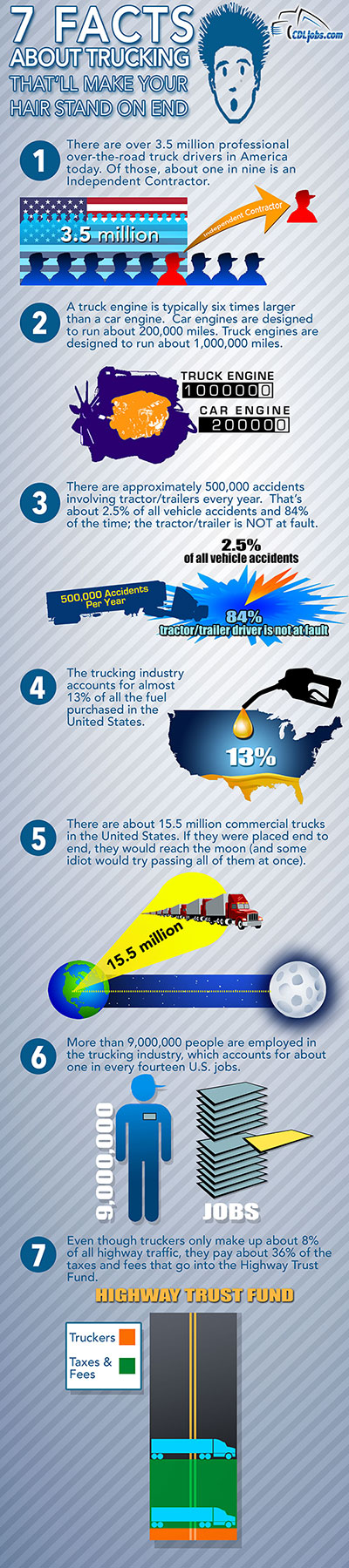
Whether you are new to the trucking industry or are a veteran driver behind the wheel of a big rig for 30 years, we think the 7 facts on this trucking infographic will make your hair stand on end!
Test Your Knowledge of the Trucking Industry
1. There are over 3.5 million professional over-the-road truck drivers in America today. Of those, about one in nine is an Independent Contractor. In addition, there are about 1.2 million trucking companies located in the United States. Approximately 97 percent of those American trucking companies have less than 20 trucks in their driving fleet.
What does this all means for the professional CDL driver looking for trucking jobs? You should know that driving jobs are plentiful among big and small carriers. You will have your choice among local, regional, and OTR driving routes that will suit your needs.
2. A truck engine is typically six times larger than a car engine. Car engines are designed to run about 200,000 miles. Truck engines are designed to run about 1.000.000 miles.
3. There are approximately 500,000 accidents involving tractor trailers every year. That's about 2.5 percent of all vehicle accidents and 84 percent of the time, the tractor trailer is NOT at fault.
4. The trucking industry accounts for almost 13 percent of all the fuel purchased in the United States.
5. There are about 15.5 million commercial trucks in the United States. If they were placed end to end, they would reach the moon.
6. More than 9,000,000 people are employed in the trucking industry, which accounts for about one in every fourteen U.S. jobs. This figure includes truck driver recruiters, dispatchers, and trucking mechanics who work behind the scenes to keep the trucking industry moving forward, as well as trucking company owners.
7. Even though truckers only make up about 8 percent of all highway traffic, they pay about 36 percent of the taxes and fees that go into the Highway Trust Fund.
For more trucking infographics, information about trucking companies, and the most up-to-date postings for trucking jobs, visit all the different options available on CDLjobs.com.
- Details
- Written by: Darin Williams
In this edition of Through The Gears, we talk with Tim Norlin, Vice President of Driver Employment at Roehl Transport in Marshfield, Wisconsin.
Tim has been working in the trucking industry in some capacity since receiving his Bachelor of Business Administration from Iowa State University's Ivy College of Business. He started in his current role with Roehl Transport in May of 2017. You may have seen him as a regular exhibitor for years at a national truck show or conference or heard him as a regular guest on XM Radio's Road Dog Trucking Network. Tim has always been a very visible presence in the trucking industry, especially as it relates to the Driver Recruiting niche.

In this edition of Through The Gears, we talk with Tim Norlin, Vice President of Driver Employment at Roehl Transport in Marshfield, Wisconsin.
Tim has been working in the trucking industry in some capacity since receiving his Bachelors of Business Administration from Iowa State University's Ivy College of Business. He started in his current role with Roehl Transport in May of 2017. You may have seen him as a regular exhibitor for years at a national truck show or conference or heard him as a regular guest on XM Radio's Road Dog Trucking Network. Tim has always been a very visible presence in the trucking industry, especially as it relates to the Driver Recruiting niche.
We recently talked with Tim to get to know him on a bit of a more personal basis.
CDLjobs.com: We assume that you have always worked in the trucking industry, so what was the first job you ever held?
Tim Norlin: I cleared tables at a popular restaurant while in high school. My first trucking job was loading and unloading trailers.
CDLjobs: What was your favorite band 10 years ago?
TN: My answer hasn't changed in more than 10 years, I like the classics. The Eagles!
CDLjobs: How do you like your eggs?
TN: Over easy.
CDLjobs: You have a lot of experience in the business side of trucking and have seen some different management styles. What has been the most valuable piece of career advice you’ve been given?
TN: It may seem simple, but the one phrase that has stuck with me the most, which just happens to fit perfectly into the Driver Recruiting world is, "If you don’t know the answer, admit that you don’t and go find it!"
CDLjobs: Conventional or Cabover?
TN: Conventional

CDLjobs: Who has had the most influence on you at Roehl Transport, and why?
TN: Our Chief Executive Officer, Rick Roehl. A lot of people might be stunned to learn that Rick still drives and delivers freight. He always wants to be able to see things through a driver’s eyes. He's making decisions at the corporate level, but he has never forgotten that it's the professional driver that directs the organization.
CDLjobs: Where did you grow up?
TN: Eastern Iowa
CDLjobs: There has been a lot of change with driver pay recently, and even some potential court cases that could have an affect on the future of our industry. If you were named "King of Trucking," what would be the first change you would make?
TN: Roehl is a company where I feel we do a great job compensating our professional drivers. An industry-wide change I would make would be to pay drivers based on performance and not just years of experience. In addition, I would pay all professional drivers for all of their on-duty time!
CDLjobs: Nobody has a better understanding of beautiful places to visit than professional truck drivers, and we've had truck drivers weigh in on their favorite places. What has been your most memorable travel experience?
TN: A self-guided tour of the Columbia Gorge Waterfalls along I-84 in Oregon. I walked 16 miles and climbed over 100 stories in one day to see them.
CDLjobs: If you were a professional wrestler, what would be your walk-out song?
TN: "Crazy Train" by Ozzy Osbourne
CDLjobs: Competition for qualified professional drivers has never been more fierce, and qualified professional drivers have a lot of good choices of where they want to work. What separates Roehl Transport from the competition?
TN: As I mentioned earlier, Roehl Transport is a truck driver’s company who is being lead by a truck driver. Unlike a lot of trucking companies, we pay PRACTICAL miles and we make sure our top performing truck drivers are our best paid truck drivers!
We're grateful that Tim was able to take some time from his busy schedule to go Through The Gears with us, and we hope you've enjoyed learning a little more about him as well. View more specific information on Roehl Transport jobs and get started on your new career today!
- Details
- Written by: Kate Williams
 Truckers recently earned a favorable ruling in a U.S. District Court in Arkansas that will likely have fair pay ramifications across the country.
In the civil lawsuit known as Browne v. P.A.M. Transport, the court’s ruling demands that truck drivers be paid at least minimum wage for their hard work. Despite the overwhelming majority of truck driving jobs paying good wages, some companies continue to set rates that underpay workers by the mile. The end result in some cases is that drivers’ overall earnings dip below the minimum wage.
Although drivers who get paid by the mile generally earn between $.027 and $0.40 per mile, when those rates include overnight time and traveling through congested areas, wages can dip to unreasonable levels. In the Browne v. P.A.M case, upwards of 3,000 drivers joined the class action lawsuit that claims they were not earning minimum wage and certainly not the living wage they deserve.
“We’re going to look at all the money (carriers) have paid a driver in a given week. And that could be mileage pay. It could be detention pay. It doesn't matter. It doesn't matter how you did it. We're going to look at the total paycheck that your driver earned and divide it by the total hours he worked,” Justin Swidler, the attorney representing the truckers reportedly said. “The trucking companies may say, ‘Well, that only includes drive time and time the driver logged on-duty, and no other time.’ And we take the decision (to mean) that you have to include all the time the driver gives with work time under federal labor laws, and that includes some of the time the driver spends in the sleeper berth.”
Downtime has been the center of some debate in the trucking industry that drivers and employees have not always agreed upon.
Court Supports Driver Compensation For Sleeper Berth Hours
Sleeper berth time has been a sore point between some companies and drivers. Freight companies sometimes view this as non-workable hours. The typical company thinking is that if the employee were operating a forklift in the warehouse, they would punch in and out. They would only earn wages while on task. Many companies do not even provide paid lunch breaks while workers are on site.
In terms of trucking, minutes and hours spent in the sleeper berth tend to be viewed as personal time in some employer’s eyes. The argument goes that if the driver were home in bed, no wages would be earned. But that argument seems to have fallen on deaf ears in the Browne v. P.A.M. lawsuit.
In the U.S. District Court in the Western District of Arkansas preliminary ruling, Judge Timothy L. Brooks reportedly said that under the Fair Labor Standards Act, drivers are entitled to total compensation that must be divided by all of their hours. Once the overall compensation is divided, it must meet the federal minimum wage standard of $7.25 per hour. The inclusion of sleeper berth hours would inherently increase the pay of low-earning truckers.
Although Judge Brooks did not stipulate or imply a new rule with regards to sleeper berth hours, he found that compensating drivers was consistent with existing federal regulations. His ruling appears to focus on the 16-hour, short-haul exemption that allows a non-CDL driver to increase their workday from 14 to 16 hours once every seven days under certain circumstances.
“The DOT regulations aim to make our roads safe, while the DOL regulations aim to provide workers with adequate compensation,” Judge Brooks reportedly states in his ruling. “If the DOT prohibits commercial truck drivers from driving more than 14 hours (sic) in a 24-hour period while the DOL requires their employers nevertheless to pay them for at least 16 hours in that same period, then this court sees nothing inconsistent or inharmonious about that state of affairs.”
The primary difference between an in-house employee and a trucker may come down to the difference between what it means to be on-duty or off-duty. A warehouse worker can leave the facility and enjoy their off-duty hours in any fashion they choose. The forklift or warehouse does not travel with them everywhere they go during off-duty hours.
That is just not the case for many professional drivers. Truckers cannot simply park the rig and abandon it out on an interstate. Being in the truck is the job, and that means drivers are on task even when not logging miles.
Underpaid Drivers Fighting To Secure Hours
It’s important to understand the earnings at issue do not include 8- to 10-hour stints of true off-duty periods. Only the two-hour, sleeper berth difference seems to be the focus of Judge Brooks preliminary ruling. However, the truck drivers’ attorney has cleared a significant hurdle in getting at least minimum wage compensation for that time.
“What the court held here is, in essence, that when you're over the road as a driver, assuming that you're not relieved from duty, and you're not going into a hotel or able to leave the truck and the load, that that's basically 16 hours a day of work per the federal regulations,” attorney Swidler reportedly said. “That would entitle you to minimum wage for 16 hours a day.”
While that may not sound like a tremendous boost to the ranks of well-paid truckers, it’s a personal game changer to the lowest paid workers in the industry. The U.S. District Court ruling appears to be a pivotal step in full, fair trucker driver compensation.
The decision so far only dispenses with P.A.M. Transport’s attempt to have the lawsuit by the alleged underpaid drivers thrown out. Judge Brooks did not issue a final ruling in the case, but his position could prompt P.A.M Transport and others in the industry to raise the bar on truck driver wages across the board.
“The hope is that, as you raise the bottom, you raise everybody,” truck driver attorney Swidler reportedly said. “That's the practical implications of what this could mean. It also means that if we can get Congress to increase minimum wage, then these drivers would get a little bit more, too.”
Moving forward, P.A.M Transport’s lawyers have reportedly asked the court set aside the class action lawsuit and force the 3,000 individual truckers to file separately. It appears to be an apparent move to undermine the economically-challenged drivers who could not afford personal lawyers. Specifically, the average truck driver salary reportedly runs between $38,338 and $50,328 and while driver pay has been climbing steadily, more experienced drivers may be pulling down six figures in many cases, which makes this move to separate the cases fundamentally unfair to working class drivers.

- Details
- Written by: Kate Williams
Truck driving is one of the most dangerous occupations in the United States. Dealing with inexperienced four-wheelers and road rage drivers adds to the stress of any trucking job. Below are some of the roadways labelled among the most dangerous in the United States. Armed with this information and knowing key factors involved in trucking accidents will help to keep truckers safe on the job.

Share this Image On Your Site
Beware: Dangerous Roads Ahead
1. Highway 2 - Montana
Miles: 63 miles in the most remote part of the state.
The Danger: For ambulances to get crash victims to hospitals, they must travel an average of 80 minutes in the vast plains. Montana also maintains a 70 m.p.h. speed zone thru winding an mountainous roads which can add to danger during incliment weather.
2. Interstate 15 - California and Nevada
Miles: 180 mile straight stretch
The Danger: This roadway has very few turns, attibuting to high speed. Half of those killed were found to not be wearing seat belts. Drinking and driving and distracted driving have also contributed to many fatalities in this stretch of roadway.
3. Lake Pontchartrain Causeway - Louisiana
Miles: 24 mile long bridge
The Danger: A Guinness World record holder for the longest continuous bridge over water. Fog can roll in so thick that drivers cannot see the end of their own vehicle on this dangerous roadway.
4. U.S. 550 - Colorado
Miles: 12 miles through Uncompahgre Gorge
The Danger: There are no guardrails and drivers who take the outside lane are perilously close to the edge of this roadway. The ascent of Red Mountain Pass is particularly scary, with its steep gradient.
5. James Dalton Highway - Alaska
Miles: 414 miles of dirt road
The Danger: While a more limited number of truckers will encounter this stretch of road, those who do must endure freezing weather, including the lowest termperature ever recorded in the United states at -80° F in 1971. This highway twists and winds around steep mountains with a minefield of potholes and there is just one fuel stop.
For those adventurous truck drivers searching for trucking jobs in these states and others, visit CDLjobs.com

- Details
- Written by: Kate Williams
 Ranked among the worst states for taxes and business, Rhode Island recently took a wrong turn by leveling truck-only tolls and now neighboring Connecticut may follow them down this unfortunate road.
But targeting the trucking industry should come as no surprise. Rhode Island and Connecticut continually rank at or near the bottom in places to do business. Failed policies, wasteful use of hard-earned taxpayer money and a lack of long-term economic leadership put these two New England states behind the eight ball year after year.
Rather than fix their inherently broken systems, politicians look for quick fixes such as truck-only tolls that exacerbate problems for residents. Both Connecticut and Rhode Island suffer unemployment above the national average and rank 42nd and 43rd in business climate respectively, according to Forbes.
Rhode Island, the first state to level an unfair truck-only toll on Interstate 95 in June 2018, ranks in the bottom 10 percent in business costs, regulatory environment, economic climate, and growth prospects according to the business magazine. Connecticut suffers bottom 10 rankings in the exact same categories.
The inherently business unfriendly environments are only made worse by now targeting hardworking men and women in the freight industry. Many organizations are vehemently opposed to the expansion of truck tolls in Rhode Island and into Connecticut.
Connecticut Poised to Level Tolls Against Truckers
Debates leading up to the mid-term elections saw candidates clash over a truck-only money grab in Connecticut. But the apparent front-runner for governor and others favor taxing trucks. The political climate in Hartford, CT, may implement another shortsighted tax-and-spend program at the trucking industry’s expense.
Democrat candidate Ned Lamont went beyond the possible tolls being just a revenue issue. Lamont accused the trucking industry for the poor conditions of the state’s roads as well.
“We should focus on the big, out-of-state tractor-trailer trucks that are coming through our state,” Lamont was quoted in the Connecticut Post following a debate. “They’re the ones that are destroying our roads.”
The gubernatorial candidate was happy to roll out a plan to hit out-of-state tractor trailers. With the same shortsighted attitude about business that outgoing Democrat Gov. Dan Malloy demonstrated, Lamont reportedly said the move would shift traffic to trains.
His plan sought to take upwards of $100 million annually from the trucking industry. Lost on Lamont is the fact that trucks reportedly pay between $26 and $35 million in Connecticut taxes annually. Gov. Malloy, also an advocate of truck-only tolls, exits the political stage leaving Connecticut in significant debt.
Rhode Island and Connecticut Suffer Self-Inflicted Debt
According to sources such as the Reuters news agency, Connecticut is drowning in debt. The state is currently suffering a shortfall of approximately $3.5 billion over the next two fiscal years.
Despite boasting some of the richest American residents, excessive taxation has resulted in wealthy people migrating to tax-friendly states. With lower tax revenues unable to keep pace with spending, Connecticut now suffers a $50 billion unfunded pension liability crisis.
Rhode Island also has a history of horrific economic management. In the 1990s, the Rhode Island Share and Deposit Indemnity Corporation closed 45 credit unions due to embezzlement. With state-run oversight, the credit unions failed to purchase federal insurance and upwards of 300,000 residents were unable to recoup their savings for years. Poor financial management is a sickness that plagues the union’s smallest state. Rhode Island reportedly carries an unfunded pension liability of more than $21 billion.
These days, Connecticut’s capital city of Hartford is considering bankruptcy. Trying to reach into the pockets of the trucking industry mirrors the bad business thinking that got Connecticut into this economic crisis in the first place. Fortunately, many industry proponents, including the American Trucking Associations (ATA), are pushing back.
ATA Lawsuit Against Rhode Island Could Deter Connecticut
Discriminating against working-class people such as truckers with targeted tolls is both un-American and likely unconstitutional. That’s why the ATA and at least three trucking-oriented companies were quick to file a federal lawsuit against Rhode Island.
“Since RhodeWorks was first proposed, the trucking industry has been strong and united in opposition to this extortionate plan. We’ve warned politicians in Rhode Island that these truck-only tolls were unconstitutional and should be rolled back,” ATA President and CEO Chris Spear reportedly said. “It is unfortunate that Governor Raimondo and her administration did not heed those warnings, but now we will see them in court.”
Rhode Island’s transportation director Petr Alviti has asked a federal judge to dismiss the lawsuit and avoid a showdown with the ATA. He appears to claim the court lacks jurisdiction over the issue. The argument fell on deaf ears with the ATA.
“Rhode Island’s motion does not attempt to refute the argument that the RhodeWorks toll scheme discriminates against the trucking industry,” an ATA spokesman reportedly said. “We look forward to our day in court and demonstrating that this financing scheme is not only harmful to our industry and to the economy of Rhode Island but that it is also unconstitutional.”
Getting fundamentally fair treatment from states such as Rhode Island and Connecticut is not only crucial to truckers, but to all working-class Americans. These states continue to the squander tax money of hard-working residents. The budget shortfalls of business unfriendly states are self-inflicted economic wounds and not the trucking industry’s fault. Hopefully, the lawsuits supported by the ATA and private trucking companies will deter Connecticut and others from discriminating against truckers.
- Details
- Written by: Kate Williams
By their nature, OTR trucking jobs require drivers to be away from home for extended periods of time, living in your semi-truck. It’s not easy, practical, or cost effective to run to a Walmart every time you think of some truck driver supplies that have been forgotten, so it is vital that professional truck drivers plan out the essentials needed for each trip.
Pre-trip planning is key to good preparedness and may vary by each route assigned, but we have compiled a basic list of essentials to build a Truck Driver Starter Pack to keep you comfortable, healthy, and safe while away from home.

Share this Image On Your Site
If you are in the market for a new truck driving job, finding local, regional and OTR truck driving jobs near you has never been easier. On CDLjobs.com, you can quickly apply to hundreds of trucking companies instantly using our online application.

Truck Driving Essentials to Bring on the Road
Personal Needs
These include the basics you would pack if going on a long vacation
- Trucking Clothes
- Pack comfy trucking attire
- Button up shirts
- T-shirts
- Jeans
- Shorts
- Jogging pants
- Off-duty Clothes - Pack comfy and season appropriate free-time clothes.
- Underwear - Pack enough to last throughout the trip or between laundries.
- Shoes - Running shoes, shower shoes and off-duty shoes
- A Jacket - Always bring a jacket, specially if you’re driving through changing altitudes.
- Safety Apparel Work Boots
- Depending on your destination you may need:
- Work Boots, use steel toe boots if you’re driving a flat bed and insulated boots for winter weather
- Hard hat
- Safety glasses
- Coveralls, to protect your clothing
- Sunglasses - Take polarized, transition prescription lenses and amber vision sunglasses.
- Raincoat - A raincoat will help you avoid getting wet and being uncomfortable for hours.
Personal Products
Stay clean for your own health and wellness (and consideration for other truckers)
- Shower Kit - Body wash or bar soap, shampoo and/or conditioner (depending on your hair situation)
- Overnight Kit
A well-stocked overnight bag should include, at a minimum:
- Toothbrush
- Toothpaste
- Dental floss
- Mouthwash
- Deodorant
- Cologne
- Include any daily medications, vitamins, or supplements and an extra pair of glasses or contacts
- Grooming Tools - Include all grooming and personal hygiene items
- Wet Wipes - For small spills or to clean up between showers
- Cleaning supplies
Examples of cleaning materials to have in your rig include:
- Laundry detergent
- Paper towels
- All purpose cleaner
- Lysol wipes
- Dashboard Conditioner
- Air Freshening Spray
- Handheld vacuum cleaner

Truckers’ Needs
While on the road, these are some essential truck driver supplies you will want to carry with you.
- Cell Phone and Charger - Make sure your chargers work in the truck.
- Trucker’s Atlas or Maps - In case other means of navigation fail
- GPS System
- Find the best routes and high quality restaurants, hotels and stores
- Locate good stopping points
- Work gloves
- For random repairs to your rig or trailer
- To make loading or unloading easier
- Emergency Kit - With food and supplies in case of a breakdown
- Emergency Gear
In case of emergency, a trucker's kit should Include:
- Emergency weather gear in case you’re caught in an unforeseen storm
- Light reflective clothes
- Sturdy pair of boots
- Road Flares and cones
- Chains for tires where there’s a chance for snow or ice
- Toolbox
- Wrench set
- Flashlight and spare batteries
- Hammer
- Screwdriver
- Pliers
- Zip ties
- Pocket knife
- Tire pressure gauge
- Brake cleaner
- Phone Number List - In case your cell phone gets broken, lost, or stolen, keep a handwritten list of numbers in your glove box.
- Document Envelopes - When you live in your rig and space is at a premium, keeping your life organized is a key to sanity.
- Use envelopes for documents like license and registration
- Use manila envelopes invoices and shipping orders
- Use other envelopes to organize work-expense receipts
Food and Snacks
It’s expensive and bad for your health to have all your meals be from fast food restaurants, truck stop buffets or the gas station. Make sure you pack some snacks and meals that are easy to make this will help save money and contribute to your health.
- No Refrigerator Needed Snacks
- Peanut butter
- Bread
- Crackers
- Baked goods
- Apples
- Bananas
- Meat jerky
- Whole grain crackers
- Sunflower seeds
- Easy to Make Meals - OTR truck drivers can easily prepare sandwiches, salads, and heat canned soups from the comfort of your rig.
Entertainment
Trucking can get very lonely, so make sure your truck driver gear includes some entertainment sources to occupy your time when on the road.
- Music Player, E-Reader, Laptop or Tablet - Check out mobile hotspots that allow you to hook up to Wi-Fi safely and securely.
- TV, DVD, Game Console - Watch movies or play games in your spare time.
- Drawing, Photography or Writing - To bring out your creative side, make sure you tote all the materials you need for these hobbies
- Magazines and Newspapers - Get issues from different places for localized reading
- Crossword Puzzles, Word Search, Sudoku, Adult Coloring - Keep your mind focused and sharp with these and any other activity books you may enjoy.
Make sure to have chargers and adapters for your electronics
Trucker Comfort
This section of items are essential if comfort on the road is what you need.
- Portable Toilet - You may want and need the convenience of going to the bathroom whenever you need.
- Indoor Sleeping Bag and Pillow - When it’s important to get the right amount of sleep, an indoor sleeping bag will take up less space and keep you comfortable in your rig.
- Cooler, Ice Chest, Compact Refrigerator - It's critical to have a device or other means to keep food cold.
By putting some thought into the truck driver gear that you need, you can compile your own Truck Driver Starter Pack for the open road. Remember, you won’t have much room in your truck, so make sure you pack light and pack smart. Safe travels!

- Details
- Written by: Kate Williams
The American Trucking Associations estimates that the truck driver shortage is currently about 50,000 to 60,000. Drivers have more opportunities now to command higher salaries, especially as unemployment numbers continue to fall. Trucking jobs can be lucrative, especially for Millennials, women, racial minorities and other demographics currently underrepresented in the driving industry. The current shortage means new drivers can make good money and negotiate more time at home.
The Reasons Behind the Huge Truck Driver Shortage
 A combination of factors has contributed to the driver shortage. Two major causes are waves of Baby Boomer truckers retiring and incredibly high turnover rates. The turnover numbers are a big reason the industry has moved to increase pay and to give drivers more time at home.
Companies are also striving to make trucking a safer job, for example, working to overhaul lighting at truck stops and adding safety features such as automatic brakes to trucks. Employers are reducing the hours that drivers have to wait at their destinations to offload cargo. Detention eats directly into truck driver pay and can be incredibly frustrating.
Trends for Truck Driving Jobs
The trucking industry, year after year, cannot fill all open positions with qualified drivers. That trend continues, keeping trucking as a stable and potentially lucrative career path. From 2018 to 2028, job growth for heavy and tractor-trailer drivers should be 4% to 6% with 238,400 projected openings, according to O*Net. For light truck or delivery services drivers, the projected growth is also 4% to 6% with 120,700 positions.
That is an incomplete picture, though. A report released by the American Trucking Associations in July 2019 indicates the need to hire 1.1 million new drivers during the next 10 years to keep pace with economic growth and to fill vacancies left by retiring drivers.
Women in Trucking
To say that women in the trucking industry are under-represented would be an understatement. Women make up 51 percentage of the population, yet only approximately 6 percent make a living as commercial drivers. Historically, traditional roles, motherhood, and the tough physical nature of driving truck inhibited the rise of female drivers. However, there have been trailblazers.
The first woman to earn a truck driver’s license was Lillie Elizabeth McGee Drennan in 1929. Although she had to secure that right through court litigation, she became the sole owner of the Drennan Truck Line.
The industry has always been dominated by men, but during the war effort of the 1940s, women were encouraged to work in traditionally male occupations such as commercial driving. And while the women’s movement beginning in the 1960s has steadily closed the gap between the sexes, trucking has largely been an equal opportunity industry. And, technology has reduced the physicality of trucking as well. With an imminent driver shortage, trucking companies are raising the bar to persuade women about the benefits of good-paying careers.
Millenials in Trucking
Given the high cost of a college degree and the struggles to get out of student loan debt, the trucking industry checks many of the boxes that younger demographics require. Of the current workforce, Millennials comprise approximately half. The age group is expected to make up 75 percent of all workers by 2030.
That being said, trucking companies have already begun promoting themselves in ways to attract a younger generation of truck drivers. Lifestyle interests rank high among this workforce demographic, so trucking companies are offering incentives such as:
- More time at home
- Reduced wait times at destinations
- Safer truck stops
- More safety features on trucks
- Free, online college tuition
- Signing bonuses
The common thread that appears to be emerging within the trucking industry is that recruiters are repositioning pay rates, incentives and lifestyle elements to engage Millennials. Darin Williams, President of CDLjobs.com, says, "Our website is designed for Internet-oriented future drivers to access information about trucking company packages and find the carrier that best meets their lifestyle needs."
Truck Driver Salaries Leave Much Room for Growth
As drivers have more options for employment, trucking companies have boosted driver salaries and continue to increase them. They've also turned to financial incentives such as signing bonuses to attract new drivers. In the 1970s, truck drivers could rake in salaries equivalent to more than $100,000 in current dollars. To get a bit more recent, here are some 1980s salary comparisons.
- Atlanta:Average hourly wage in 1980 stood at $30.13. The 2018 rate averaged $18.38 for light truck or delivery services drivers and $21.15 for heavy and tractor-trailer drivers.
- New York City:The hourly wage averaged $29.18 in 1980. The 2018 rate averaged $19.12 for light truck or delivery services drivers and $25.40 for heavy and tractor-trailer drivers.
- Chicago:In 1980, drivers saw an average high of $34.39 compared with 2018's $19.81 for light truck or delivery services drivers and $24.19 for heavy and tractor-trailer drivers.
As you see, heavy and tractor-trailer drivers earn more money than their light truck or delivery services driver counterparts. For one thing, employers generally have stricter requirements for heavy and tractor-trailer drivers. Plus, these drivers tend to be away from home more and drive farther.
Signing bonuses are also an incentive that many employers in the trucking industry are utilizing to entice seasoned and even rookie drivers to join fleets. According to reports, signing bonuses have ratcheted up from about $1,700 in 2017 to a whopping $6,000 in 2018. With freight rates up as well, drivers are well-positioned to see further incentives and pay bumps.
How to Start a Career as a Truck Driver
To become a professional truck driver, candidates typically must:
- Have a high school diploma or equivalent
- Finish truck driving school
- Pass a driving and knowledge test to get a commercial driver's license (CDL)
- Obtain any necessary CDL endorsements such as hazardous materials (H)
- Pass a physical every two years
- Maintain a clean driving record
Light truck or delivery services drivers can work with a high school diploma as well. They are usually trained on the job, and CDLs are not required.
Ready to Get Started with a New Career in Trucking?
Without a doubt, truck driving will continue to rank among the most secure and high-paying blue-collar occupations going forward. Salaries could easily surpass the golden era of trucking over the next decade. If you are interested in joining the men and women who keep America’s goods and products flowing, the future may hold a wealth of opportunities for both beginner and veteran truckers. Start browsing truck driving jobs and apply online today.

- Details
- Written by: Kate Williams
 Trucking is a great way to see the world, but there are a few downsides. Trying to determine whether the diesel prices in front of you are the best or if fuel is cheaper ten miles down the road? Wondering if you should mentally prepare for rain or will enjoy a few more hours of smooth sailing down the interstate? These questions and many more are likely running through your head as you are trucking along.
The good news is you have technology today in the palm of your hand that can answer many of these questions for you! Just download some of the best trucking apps to help you get your job done.
If you are not currently using an Apple or Android smartphone or tablet to save time and money on the job, then you are in for a treat. There are literally hundreds of trucking apps available, but only a few of them have made our "best of the best" list for truckers, small trucking fleet owners, and Owner Operators.
Predicting the Weather
Driving in inclement weather is probably not your first choice, so why not schedule around it when you can? While it won't always work out, there are times that you can schedule a break around a massive rainstorm that is supposed to be short-lived. If you are on a tight schedule and cannot stop or pull over, at least you can mentally prepare for the deluge of rain, hail or snow headed your way! These apps will help keep you safe on the road:
- Weather Channel App: Easy to use and highly reliable, the Weather Channel App allows you to check the radar and forecast hour by hour regardless of your physical location.
- DriveWeather | App for Truckers: Track the forecast along your long-haul route by departure time or compare weather conditions along different routes to your destination.
Getting (or Staying!) in Shape
 Numerous physical health studies have touted the long- and short-term health benefits derived from even short stints of physical activity. While it is essential for drivers to take their mandated break in service hours, getting up and moving around during part of this time may also be beneficial for their health, to help drivers keep their focus on driving conditions, and maintain a strong safety record.
The long hours of sitting behind a steering wheel can really take a toll on a truck driver's body, and it isn't always easy to find healthy, nutritious food at truck stops. It's incredibly important to protect your long-term health by looking for ways you can compromise, either with quick exercises you can fit in during a stop or by being more aware of how many calories you're eating on a daily basis.
These apps will help you track your physical movement and provide much-needed motivation to get (or stay!) in shape on the road:
- My Fitness Pal: Track your daily food intake as well as your carbs, sugars, fats and how much water you're drinking. Staying well-hydrated can be a challenge, especially when you need to limit stops on the road. You can even see how many calories you are burning when you do some in-cabin crunches or leg lifts!
- Lost It!: This community-based weight loss app provides you with easy access to food and exercise tracking, as well as a way to get in contact with others who are on a similar journey to improve their health. Track progress against goals and stay motivated with this mobile app.
- FatSecret Calorie Counter: Fast and easy to use, FatSecret Calorie Counter provides nutritional information for thousands of restaurants and foods at your fingertips. You can record your progress and calories and track what you are eating and drinking, too.
Keep Your Truck's Weight Under Control Too!
Going to a weigh station is a necessary evil for many truck drivers, but did you know that there's sometimes a way around this hassle? Mobile apps today are able to help you skip the lines and breeze right through -- provided your carrier safety score is high enough, of course. If your score isn't where it needs to be for a bypass, you can find friendly weigh stations with these apps:
- Drivewyze Weight Station PreClear: With over 100,000 downloads, Drivewyze is a prized tool for many truckers throughout the states. Over 700 sites accept the Drivewyze app to keep you on the road and skip the weigh-in. Plus, the app is a lightweight and won't drain your battery -- even as it notifies you when you're within 2 miles of a weight or inspection station.
- Weigh My Truck App: Saving time at weigh stations is a big deal, and with the Weigh My Truck app you're able to pay for your weight using your smartphone right at the scales -- no need to leave your truck! You will receive your weigh ticket via email or you can still opt for a hard copy for your records.
Your Digital Co-Pilot
Not everyone has the luxury of having a live co-pilot on the road, so why not opt for a digital assistant? These apps can do nearly everything for you, from plotting the best route to managing important documents and logistics and even storing a digital log book.
- CoPilot Truck Navigation: While not a free app, the benefits you'll gain with this long-haul digital assistant may be worth the price. Find the most efficient route, stay away from any potential restrictions and this app could potentially save you a great deal of money over the course of the year.
- Big Road: This digital log book cuts down on the potential for human error and even calculates your available drive time automatically. The interactive map is another boon for long-haul truckers. Of course, this app is just a recommendation and will not replace the ELD system your company has selected!
- Gas Buddy: Are you always on the lookout for the best prices on gas? Look no further! Gas Buddy utilizes your GPS to find truck-friendly stations with a great price.
- AllStays: When you need to take a break, you may have certain requirements. Showers? Clean restrooms? Laundry or a game room? AllStays has the details that will keep you covered. You can even include specific restaurants in your search requirements!
Staying safe on the road is the first requirement of the job, but eating right, staying healthy and enjoying your day are also important. This list of the best trucking apps was built to help you stay out of the way of bad weather, find the goods and services that you need and get your job done.
Are you looking for a new trucking job opportunity? CDLjobs.com offers a simple search engine that will connect you to the top paying truck driving jobs in the country. Start looking today -- you are one step closer to finding your dream job!
- Details
- Written by: Kate Williams
 American truck drivers are responsible for moving the food and products that keeping the nation going. While truckers do immeasurable good for everyday people, underworld figures are using our roadways for human exploitation.
Human trafficking has become an international plague that garners billions of dollars for criminals by victimizing women, children and the most vulnerable. The United States has not been exempted from these horrific crimes and that’s why government, law enforcement, and trucking industry advocates such as Truckers Against Trafficking and CDLjobs.com are doing their part to raise awareness and save lives.
By getting the facts about human trafficking and what the hard-working men and women of the open road can do, you can put heinous offenders behind bars and end the misery.
Facts About Human Trafficking
The reprehensible practice of human trafficking remains a massive, global industry that reportedly generates upwards of $32 billion each year. Greed and total disregard for other people keeps this cancer on humanity afloat. These are the facts about human trafficking reported by the International Labor Organization.
- Approximately 40.3 million people are forced into modern-day slavery.
- Approximately 24.9 million people are used for forced labor.
- Approximately 4.8 million people are sexually exploited.
- Approximately 4 million people are forced into state-sanctioned labor.
- Approximately 16 million people are forced into private sector industries, such as construction, manufacturing and mining.
- Approximately 3.8 million people are forced into domestic help.
- Approximately 1.7 million people are forced into agriculture labor.
- Approximately 71 percent of all victims are female.
- Approximately 29 percent of all victims are male.
- Approximately 74 percent of all sexually exploited human trafficking victims have been transported outside their country of origin.
According to the U.S. Department of State, upwards of 800,000 people are transported across international borders. Approximately 80 percent of those are women and half of them are mothers.
Human trafficking stands as a catastrophic global enterprise that often operates in plain view. Farms, manufacturing plants and domestic workers are not disguised like underground sexual exploitation schemes. That means this problem extends far beyond major organized crime syndicates such as drug cartels. Human trafficking is big business involving a variety of sectors and these are the numbers, according to the International Labor Organization.
- Human trafficking garners a $150-billion profit annually.
- Approximately $99 billion in human trafficking profits come from sexual exploitation.
- Approximately $34 billion in human trafficking profits come from construction, manufacturing, mining and utilities.
- Approximately $9 billion in human trafficking profits come from agriculture, forestry and fishing.
- Approximately $8 billion in human trafficking profits come from domestic labor.
In many cases, truck drivers unknowingly find themselves on the front lines of these criminal enterprises. The good men and women behind the wheel are the eyes and ears that can save others from the horrors of exploitation.
Truck Drivers Can Help Stop Human Trafficking
The first step toward thwarting despicable human trafficking on America’s roadways is awareness. Truck drivers have emerged as a top resource for law enforcement to crack down on this global epidemic. By recognizing red flags at truck stops and among people you come into contact with, victims can be rescued and criminals will do real jail time. Consider some of these tell-tale signs:
- Be on the lookout for minors lingering around truck stops who may be victims of sexual exploitation.
- Be cognizant of minors who appear to be under the control of adults who are not family members.
- Watch for physical signs of abuse or drug addiction.
- Look for signs of human branding and gangland tattoos.
- Listen on your CB radio for code words such as “Commercial Company.”
- Listen for covert conversations that may pertain to child trafficking.
 Many truck drivers come into contact with high-trafficking sectors such as agriculture and manufacturing among others. These are some of the signs that workers may be victims of exploitation.
- A worker is not free come and go.
- A worker is a minor in a hard-labor position.
- A worker is not paid or works only for gratuities.
- A worker puts in excessive hours.
- A worker does not enjoy reasonable rest and lunch breaks.
- A worker mentions they are financially indebted to the company.
- A worker was delivered to the company under false pretenses.
Many human trafficking organizations will have excessive security camera systems and cover up windows to prevent public views. Along with these warning signs, people suffering from human trafficking and exploitation may appear malnourished, lack proper health care, avoid making eye contact, have limited personal belongings, and show marks of physical abuse.
Major Trucker Initiatives Combat Human Trafficking
All across the country, local and state programs are being launched to help educate members of the trucking community to recognize the signs of human trafficking.
Truckers may be shocked to know that while there are millions of people forced into labor, only 1,038 cases were prosecuted during 2016, according to the U.S. Department of State. Also, the Department of Justice was only able to secure 439 human trafficking convictions.
Law enforcement relies on everyday citizens to provide real-time information about these illegal activities. Truck drivers that “see something and say something” on the open road may be the best hope to save these ensnared souls.
In April 2018, San Francisco District Attorney requested $1.4 million to support the creation of a human trafficking unit. The call to fund 10 new positions armed with critical tools comes on the heels of a Department on the Status of Women report that discovered an additional 529 survivors in San Francisco.
Although the California city has long suffered a growth in illicit sex operations including massage parlors and brothels, prosecutors were only able to file charges in six out of 10 cases. The harshest conviction resulted in a 97-year prison sentence.
In Colorado, law enforcement plans to maximize truckers’ unique position on the state’s highways by making human trafficking awareness a centerpiece of CDL training. A recently passed law requires CDL applicants to undergo a course that educates and enlightens them about how to recognize signs of human trafficking.
“It’s my understanding that the majority of sex-trafficking cases and labor-trafficking cases are identified by members of the public,” Colorado state Rep. Dominique Jackson reportedly said. “And those members of the public include truckers. Truckers tend to be at places where people come in and out of — motels, truck stops and gas stations. They see a lot of things.”
Leaders in the truck driving industry such as the Colorado Motor Carriers Association and Truckers Against Trafficking overwhelmingly support such legislation.
“It was really something that a lot of our companies and drivers have embraced,” Colorado Motor Carriers Association Pres. Greg Fulton reportedly said. “It’s like having an army of additional eyes and ears out there to be monitoring this.”
Numerous trucking operations across the country are already engaged in providing human trafficking training to driving professionals. Organizations such as Truckers Against Trafficking reports that since launching its advocacy initiative in 2009, upwards of 2,000 truckers have generated leads to a national human trafficking call center. The information provided by truckers provided actionable intel on 545 cases and 1,000 victims. Truckers Against Trafficking has reportedly provided training to nearly 500,000 industry professionals.
As great American truck drivers, you can do your part by reporting your observations to law enforcement by dialing 9-1-1 or resources such as the National Human Trafficking Hotline at 1-888-373-7888. As veterans of the open road, your eyes, ears and instincts can save lives.
Looking for truck driving job opportunities? Research trucking companies hiring drivers and apply in just a few minutes!
- Details
- Written by: Kate Williams
The trucking industry is one where drivers face significant pressure, both from the trucking companies for which they work and from lawmakers who seek to keep other motorists safe on the roads. Unfortunately, this ends up placing a significant amount of stress upon drivers as they try to follow the rules and avoid accidents all while meeting deadlines and getting deliveries to the recipients on time.
 Many of the laws surrounding trucking were created by bureaucrats who have no personal understanding of the pressures of the trucking industry. This means that truckers are left to manage unrealistic expectations in a time-pressured field.
Here are five specific areas where truckers experience unfair expectations as they try to do their jobs safely and effectively.
1. Unfair Weight Requirement Regulations
Weight regulations are essential to keeping truckers safe, because they protect drivers from taking heavy loads on roads and bridges that can't support them. However, the current regulations surrounding weight requirements may be unrealistic.
Truck drivers all understand the weight requirements in the areas they primarily travel. Unfortunately, many shippers do not have on-site scales. This leaves drivers in a vulnerable position after picking up a load. They have no choice but to drive that load to the nearest scale to determine if they are legal or not.
What happens when a driver is stopped before reaching the scale? If the driver is overweight, hefty fines may result, even if the problem is easily managed by sliding the tandems or adjusting the load. The driver has no control over this scenario, because the only way to learn if the truck is overweight is to drive to the nearest scale.
Thanks to technology and apps now available to drivers, they have the ability to check for nearby weigh stations and determine if they are open or closed, among other things.
2. Waiting for Loads Leads to Hours-of-Duty Problems
Most drivers are careful about ensuring they are not driving with too many hours, because the potential fines are quite high. However, sometimes it takes hours for a load to be loaded or unloaded once a driver reaches a destination. If that driver started the day early, drove to a destination and then had to wait several hours, it's possible that the fourteen hour limit will be met before the load is even complete. This requires the driver to shut down for ten hours before driving again, even if some of the fourteen hours were sitting waiting for a load. Many think that the problem of excessive detention might be lessened if some sort of economic consequences were imposed by the brokers to encourage shippers to move truckers through their facilities more quickly.
 To make matters worse, after detaining drivers, many shipping and receiving companies will not allow drivers to stay on the property after receiving the load, forcing drivers to move on to the nearest safe parking spot before signing off for the required time. If the driver is stopped on the drive from the shipping company to the place where he can rest, again, he may be fined.
Once more, this scenario is one where the driver has little control yet would be responsible for any the fines that could result.
3. Unfair Expectations for Delivery Times
Drivers cannot control factors like traffic, times spent waiting for loads and time spent on truck maintenance while on the road. Unfortunately, companies often place unfair expectations on drivers as to the amount of time it will take to deliver a load. This pressure can force the driver to push past the hours of duty regulations in order to meet load delivery deadlines, which can open the door, yet again, to fines and penalties. Trucking companies need to understand that traffic, weather and maintenance issues can arise on the road, and truckers need the freedom to handle them as they come along without fear of penalties from their companies because deliveries were not as quick as expected.
Unfortunately, the demand for speed leads to poor safety in a number of areas. When an automated system warns dispatch that a load is going to be late, and the dispatcher contacts the driver to indicate that they need to speed things up or risk being late, the driver has few options. Those options include speeding at a rate that is unsafe for conditions or skipping mandatory rest periods, both of which make the driver less safe. Of course, if the pressure to deliver on time leads to unsafe driving practices that result in an accident, the driver is also held liable for the accident.
4. Lack of Parking Options Makes Hours of Duty Mandates Challenging
Hours of service (HOS) regulations make sense from a safety standpoint, but a closer look at the places where truckers can safely park makes it clear that this particular rule may not be as reasonable as once thought. A shortage of truck parking spaces in safe areas makes it very difficult for drivers to take their 10 hours off after working 14 hours, especially for OTR drivers.
This particular problem was brought to light in 2009 when a truck driver by the name of Jason Rivenburg was robbed and murdered while parked during his off duty hours. Because he did not have a safe, well-lit area to park, but rather had to stop at an abandoned gas station to rest, he was an easy target. This tragedy has pointed out the problem connected to inadequate numbers of parking areas for truckers. After Jason's murder, lawmakers passed Jason's Law, which designated funding aimed to help states creating safer parking areas for truckers spread out more evenly along major roadways.
On a state-by-state basis, drivers are beginning to find some relief using technology designed provide truck drivers with real-time data on available truck parking spots at public rest areas and private truck stops. The State of Iowa spearheaded a Federally-funded program, along with Indiana, Kansas, Kentucky, Michigan, Minnesota, Ohio, and Wisconsin to bridge the information gap and help truckers find safe parking. This program launched in 2019.
Phil Mescher, project manager for the Iowa Department of Transportation stated, “We are committed to providing the means for safe, efficient, and convenient travel throughout the state. Having this system in place will help truck drivers better manage their hours of service and provide a safer, more efficient travel experience for motorists along I-80.”
But this isn't enough. Drivers face a parking shortage nationwide and more needs to be done.
Todd Spencer, president and CEO of the Owner-Operator Independent Drivers Association (OOIDA) believes, “After decades of ignoring the problem, Congress is finally getting serious about fixing the severe lack of truck parking across the country. Finding a safe place to park is something most people take for granted, but it’s a daily struggle for hundreds of thousands of truckers.”
Representatives Mike Bost (R-IL), who grew up in a trucking family, and Angie Craig (D-MN), both members of the House Transportation and Infrastructure Committee, introduced the Truck Parking Safety Improvement Act on March 9, 2020. If passed into law, the bill will dedicate $755 million dollars to expand the availability of truck parking nationwide and address parking safety issues, while helping truckers remaining compliant with HOS regulations.
5. Pay by the Mile Neglects Considering Drivers' Time
Driving truck means a lot of time waiting - waiting in traffic, waiting at load sites, waiting while conforming to hours-of-duty regulations. Unfortunately, many trucking companies have business models that pay drivers by the mile. The end result is that drivers are not always fairly compensated for all of their time, given that some time is spent waiting, for various reasons, instead of rolling down the road earning by the mile. When drivers are not driving, they are typically not getting paid.
The trucking industry is currently facing a very significant truck driver shortage. If the goal is to attract new and younger candidates for truck driver jobs, they are going to need to address some of these problems facing them. Only when drivers do not face unfair expectations and are paid competitively will the industry be able to add new, qualified truck driving professionals and move forward with confidence. While there are many struggles apparent, truck driving jobs can be very lucrative and the present driver shortage shifts the bargaining power in the favor of those drivers looking to enter or advance in the trucking industry.